

Summary: Week of 10/25/25
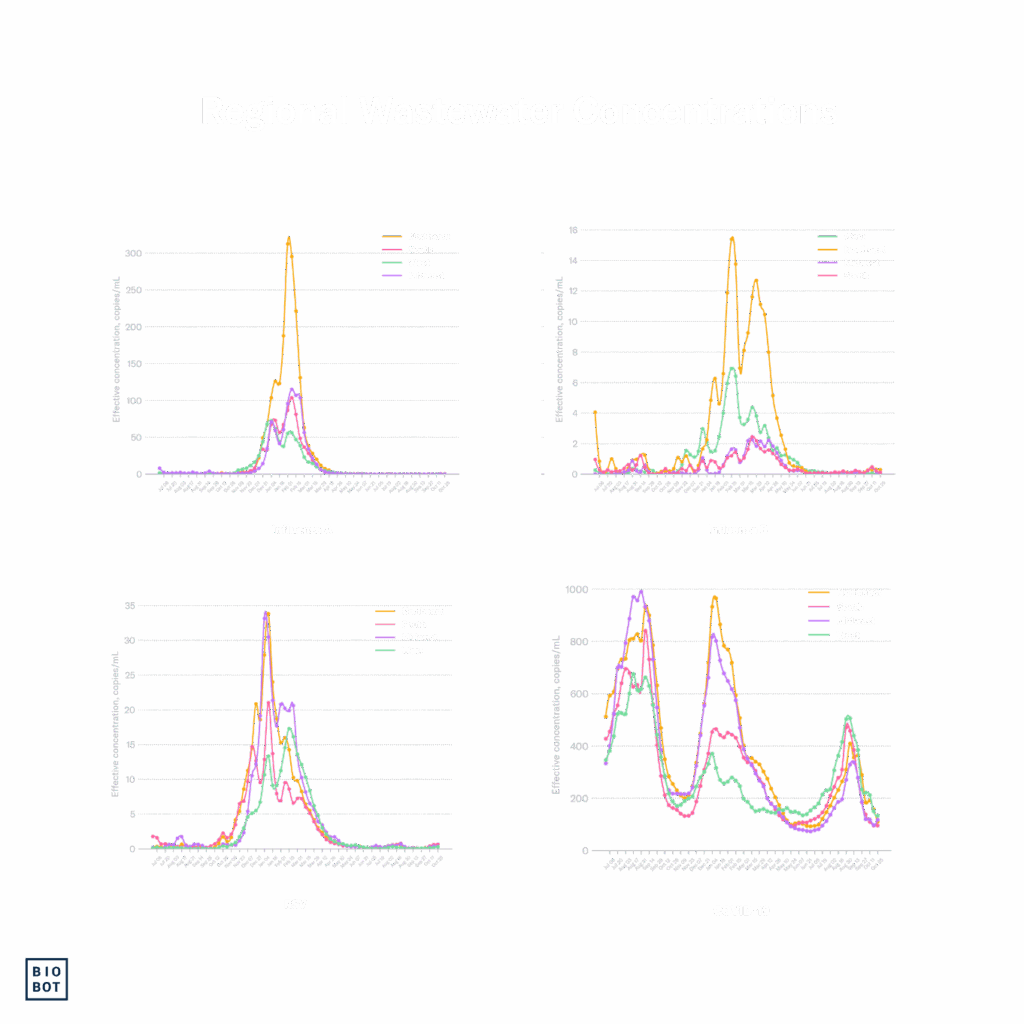
Biobot’s national wastewater network shows that RSV continues to slowly pick up in the South through October 25 (week 43). COVID-19 is continues to decrease and influenza A and B are holding steady at very low levels. Due to the government shutdown, the CDC is not updating their dashboards, so we don’t know the current hospitalization rates for any of the respiratory viruses. They have not been updated since September 20th.
The Bottom Line: The RSV season has started and is slowly picking up. COVID-19 and flu remain low, though we are keeping a close eye on both.
National Outlook
COVID-19
National SARS-CoV-2 concentrations are decreasing.

Influenza
National flu A and B concentrations are holding steady at very low levels.

RSV
National RSV concentrations have started slowly increasing—the RSV season is here.

Regional
The South
COVID-19: SARS-CoV-2 concentrations are decreasing in the South.
Influenza: Influenza A and B concentrations are holding steady at very low levels in the South.
RSV: RSV concentrations are increasing in the South, though remain low.
The Midwest
COVID-19: SARS-CoV-2 concentrations slightly increased in the Midwest but are still low.
Influenza: Influenza A and B concentrations are holding steady at very low levels in the Midwest.
RSV: RSV concentrations are holding steady at very low levels in the Midwest.
The Northeast
COVID-19: SARS-CoV-2 concentrations are decreasing in the Northeast.
Influenza: Influenza A and B concentrations are holding steady at very low levels in the Northeast.
RSV: RSV concentrations are holding steady at very low levels in the Northeast.
The West
COVID-19: SARS-CoV-2 concentrations are decreasing in the West.
Influenza: Influenza A and B concentrations are holding steady at very low levels in the West.
RSV: RSV concentrations are holding steady at very low levels in the West.


Footnotes:
We continue to monitor the evolving H5N1 influenza virus situation, and can now test samples specifically for H5 (including H5N1) — see our blog here and please reach out to hello@biobot.io if interested. A quick reminder that Biobot’s influenza A assay described in this report includes the H5N1 influenza subtype, which is an influenza A virus, but does not distinguish between the different subtypes of influenza A (e.g. H5N1 vs H1N1). We will share any important updates as we have them via Bluesky and in the risk reports.

Wastewater data from Biobot Analytics for RSV, influenza, and SARS-CoV-2 are through October 25, 2025 (MMWR week 43). Clinical data for RSV, influenza, and COVID-19 from the Centers for Disease Control and Prevention have not been updated since September 20, 2025 (MMWR week 38) due to the government shutdown.